
motion planning ·
Wildfire: Grid A* vs. PRM in a Pursuit Game
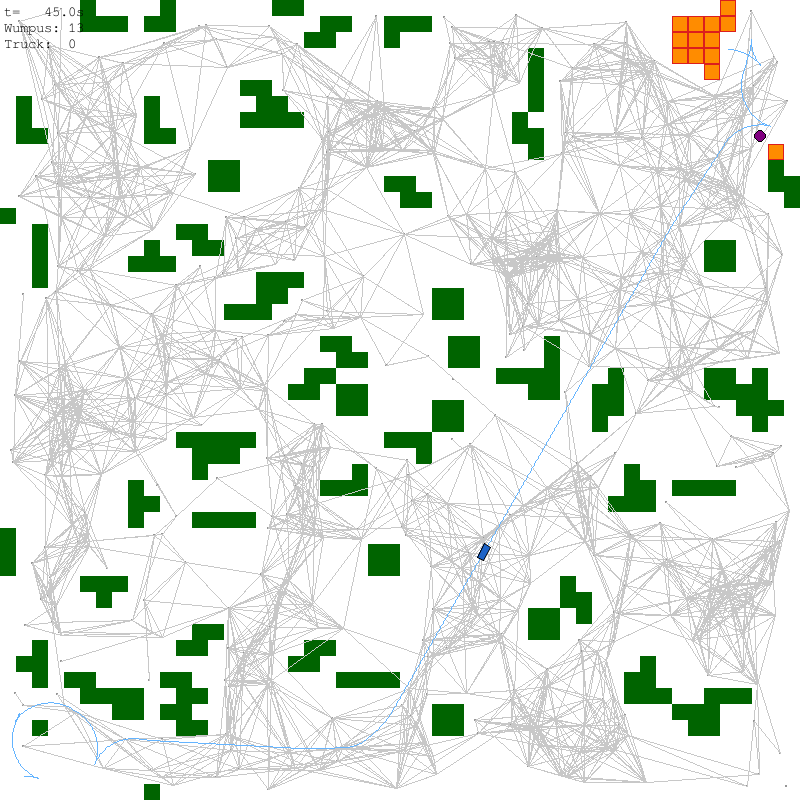
A competitive simulation between two planners. The “Wumpus” — a grid-based arsonist — walks an obstacle field igniting tetrominoes, while a firetruck with Ackermann steering chases the fires down and extinguishes them. The Wumpus plans with discrete A* on the grid; the truck plans over a Probabilistic Roadmap with Reeds-Shepp local connections. Five randomized 3600-second rounds decide a champion. Built for RBE 550 (Motion Planning) at WPI.
Full report (PDF) ↓ Explore the codebase ↓
The Ackermann kinematics, Reeds-Shepp trajectory generation, and two-phase collision checker carried over from the valet project the new work is the fire mechanics, the roadmap planner, and the two agents. Neither agent got a sophisticated high-level strategy on purpose — the point is the planners, not game theory.
Fire Mechanics
The field is 250 m × 250 m in 5 m cells, seeded with tetromino obstacles until 10% of cells are occupied. Each obstacle runs a small state machine:
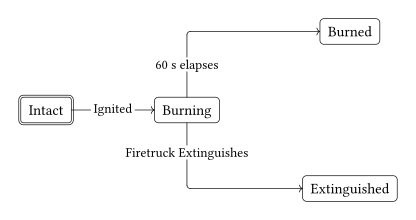
Ten seconds after ignition, a Wumpus-lit obstacle spreads fire to everything intact within 30 m; obstacles lit by spread only creep to their immediate grid neighbors. (Unlimited chain reactions were tested first — lighting a single obstacle auto-won the game for the Wumpus via cascade, so the rule was reined in.) A burning obstacle burns out after 60 seconds if the truck doesn’t get there first.
The Wumpus: Discrete A*
The Wumpus moves cell-to-cell and ignites obstacles adjacent to it, picking targets that trade off two objectives — far from the truck (so fires get time to spread) but not too far from itself:
Navigation is textbook A* on the 50 × 50 occupancy grid with 8-connected moves and an octile-distance heuristic. Replanning happens whenever the target burns down on its own or the path runs out — and each replan costs so little it barely registers in the CPU budget.
The Firetruck: PRM
The truck is a Mercedes Unimog — 4.9 m long, 13 m minimum turning radius, 10 m/s top speed — which makes its planning problem fundamentally continuous. It gets a Probabilistic Roadmap built once at simulation start: 500 collision-free poses sampled by rejection, each connected to its 15 nearest neighbors (via a KDTree) when a Reeds-Shepp trajectory between them under 50 m long clears all obstacles at 1 m resolution.
A query then stitches: connect the start pose to the nearest reachable roadmap node, find an escapable goal pose — eight candidate headings are tried until one can connect back to the roadmap, so the truck never strands itself on arrival — run A* over the graph, generate dense Reeds-Shepp trajectories per segment, and smooth the result with 200 rounds of probabilistic shortcutting.
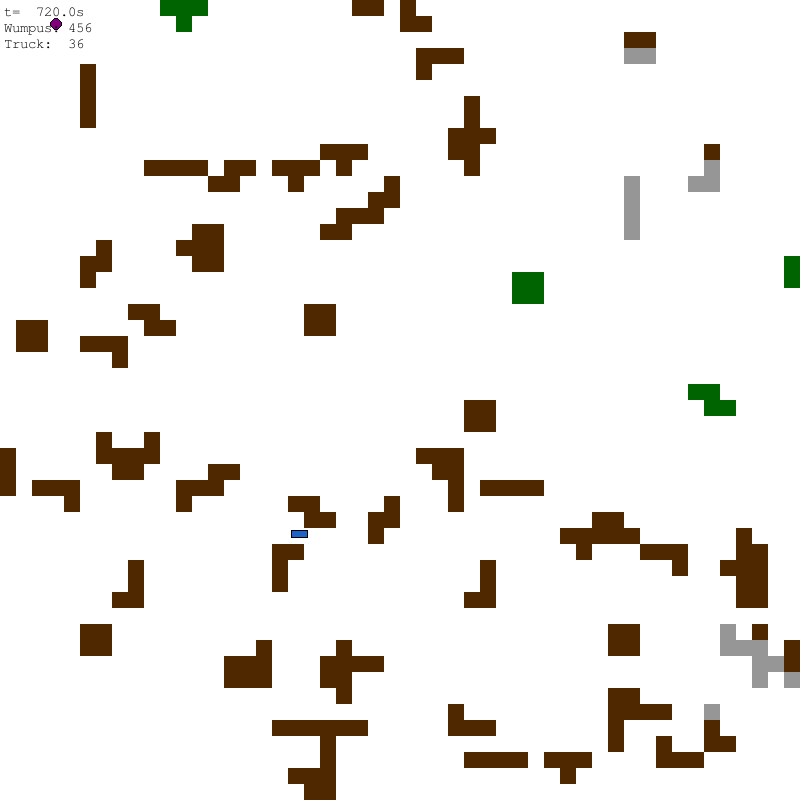
The escapability rule exists because unvalidated poses are traps:
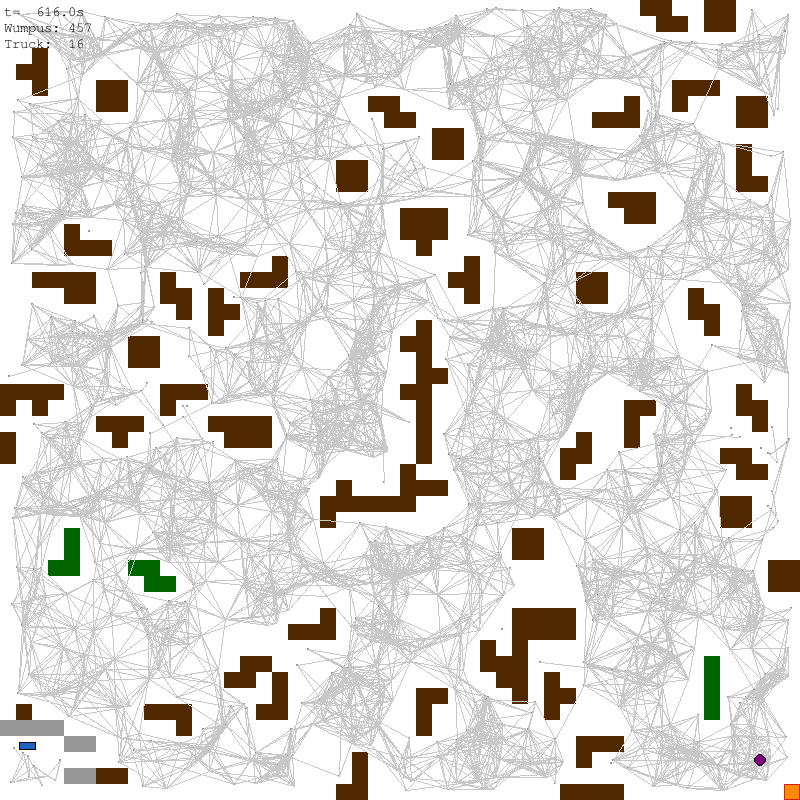
A rarer failure is the start pose itself being geometrically isolated from every sampled node — then the truck simply never moves:
Results
| Run | Seed | Wumpus | Truck | Winner | W-plan (s) | T-plan (s) |
|---|---|---|---|---|---|---|
| 1 | 3235666703 | 264 | 214 | Wumpus | 0.039 | 2.809 |
| 2 | 3235666704 | 246 | 254 | Truck | 0.039 | 3.581 |
| 3 | 3235666705 | 236 | 260 | Truck | 0.036 | 2.790 |
| 4 | 3235666706 | 222 | 260 | Truck | 0.036 | 3.356 |
| 5 | 3235666707 | 276 | 230 | Wumpus | 0.034 | 2.831 |
| Total | 1244 | 1218 | Truck 3–2 | 0.184 | 15.367 |
The truck took the series 3–2, but the efficiency story runs the other way: 1218 points over 15.4 s of planning ( 79 points per CPU-second) against the Wumpus’s 1244 points over 0.18 s ( 6900 points per CPU-second). Grid A* is orders of magnitude cheaper than building and querying a roadmap — the truck spends about a second up front on construction and another 1.5–2.5 s per run on queries.
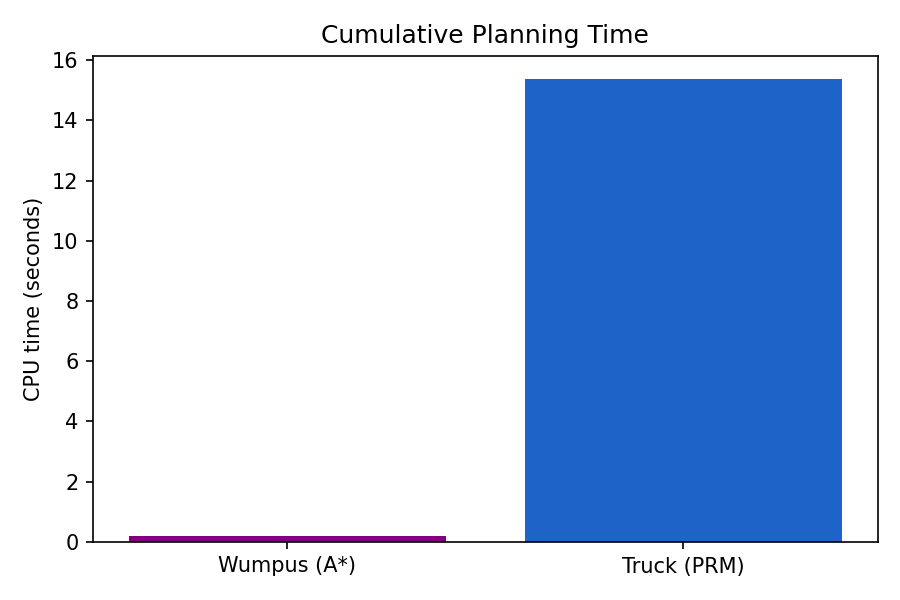
Each planner fits its constraints: the Wumpus’s cell-by-cell motion is exactly what grid A* models, and its paths are grid-optimal by construction. The truck can’t turn tighter than 13 m, so only a planner with kinematically-correct local connections produces paths it can actually follow — and its paths are suboptimal at several levels (sparse sampling, k-nearest connectivity, partial smoothing), which matters less than reliably arriving.

References
- Kavraki, L. E., Švestka, P., Latombe, J.-C., & Overmars, M. H. Probabilistic roadmaps for path planning in high-dimensional configuration spaces, IEEE T-RA, 1996.
- Reeds, J. A. & Shepp, L. A. Optimal paths for a car that goes both forwards and backwards, Pacific Journal of Mathematics, 1990.
- LaValle, S. M. Planning Algorithms, Cambridge University Press, 2006.
- Geraerts, R. & Overmars, M. H. Creating High-quality Paths for Motion Planning, IJRR, 2007.