
motion planning ·
Valet: Hybrid A* Across Four Vehicle Types
A motion planning simulator that parks four vehicles of increasing difficulty — a holonomic point robot, a differential drive, an Ackermann car, and a truck towing a trailer — through randomly generated obstacle fields, using Hybrid A* search. Built for RBE 550 (Motion Planning) at WPI.
Full report (PDF) ↓ Explore the codebase ↓
The project doubled as a testbed for two experiments: Python’s structural typing (typing.Protocol and generics, inspired by Rust traits) to keep the four vehicle types interchangeable without an inheritance hierarchy, and Typst for the report — which came out deliberately excessive, because it was fun to make it so.
The Environment
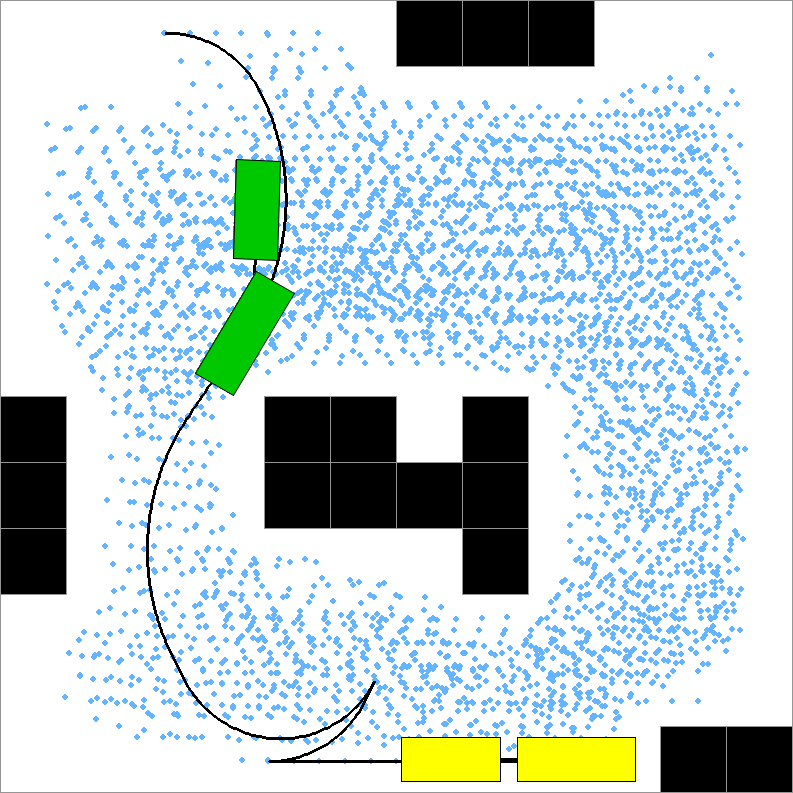
Each run scatters tetrominoes across a fixed grid until 10% of it is occupied, storing the result twice: a NumPy boolean grid for cheap lookups and a Shapely STRtree for exact intersection tests. The vehicle starts in the top-left corner and must reach a goal pose in the bottom-right — for the car, a parallel-parking spot against the bottom wall.



Hybrid A*
Hybrid A* is A* over a continuous state space: nodes carry exact states (plus the trailer heading when towing), and successors come from integrating sampled control inputs forward rather than stepping between grid cells. A discretized grid is used only for duplicate detection, so the search can’t churn through near-identical states forever.
Motion Primitives
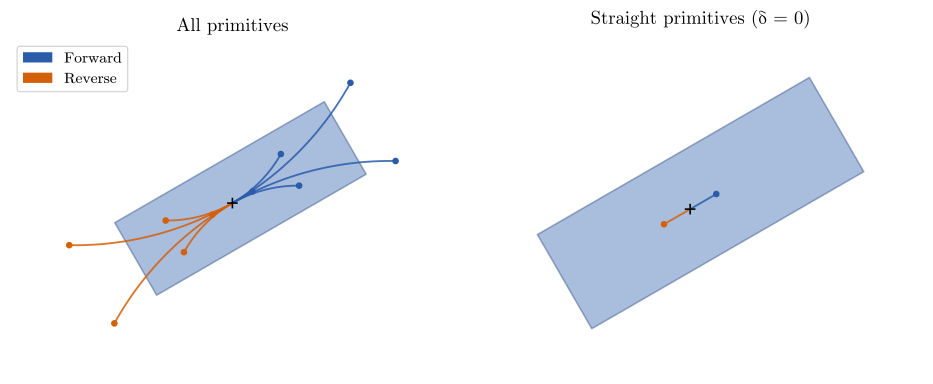
Each expansion samples steering angles (or angular velocities, for the differential drive) crossed with forward/reverse. Holding the controls constant makes every primitive a circular arc, which has a closed-form solution — no numerical integration in the hot loop:
where is the signed turning radius. Ackermann and differential-drive kinematics both reduce to this same unicycle model; they differ only in which values they can produce. The differential drive can hit (spin in place), so it gets extra rotate-in-place primitives whose cost is pure heading change — without them the planner can’t exploit the drivetrain’s signature move.
The heuristic is the obstacle-ignorant Reeds-Shepp path length to the goal — admissible, and much tighter than Euclidean distance for vehicles with a minimum turning radius. Landing exactly on the goal pose through discrete primitives is unlikely, so once the search gets within a terminal radius it starts attempting “last shot” closed-form connections (Reeds-Shepp for the car and trailer, rotate-drive-rotate for the differential drive), gated by a probability that scales up as the distance shrinks — each attempt costs a full collision check of the candidate path, so it’s only worth trying where it’s likely to be clear.
Making Collision Checking Fast
Shapely was the correct-if-slow reference implementation: obstacles in an STRtree, vehicles as rotated polygons, exact intersection predicates. Profiling showed it dominating the runtime, so two optimizations were layered in front of it — chosen from cProfile data, not guesses.
Heading Cache
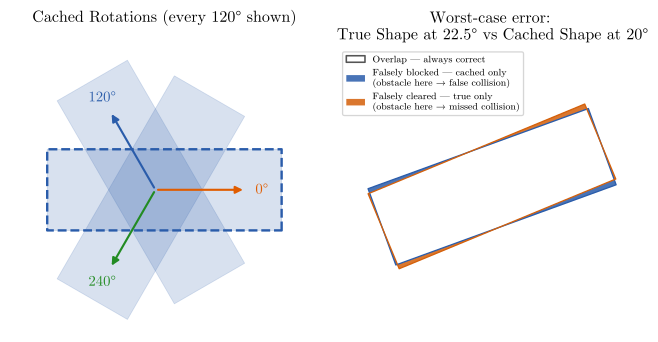
Rotating a Shapely polygon walks every vertex through a matrix multiply, and the planner was doing it nearly a million times per run. Instead, each vehicle’s footprint is pre-rotated to 72 headings (every 5°) at startup; a state query snaps to the nearest cached shape and defers the (cheap) translation until an exact check is actually needed.
AABB Rejection Filter
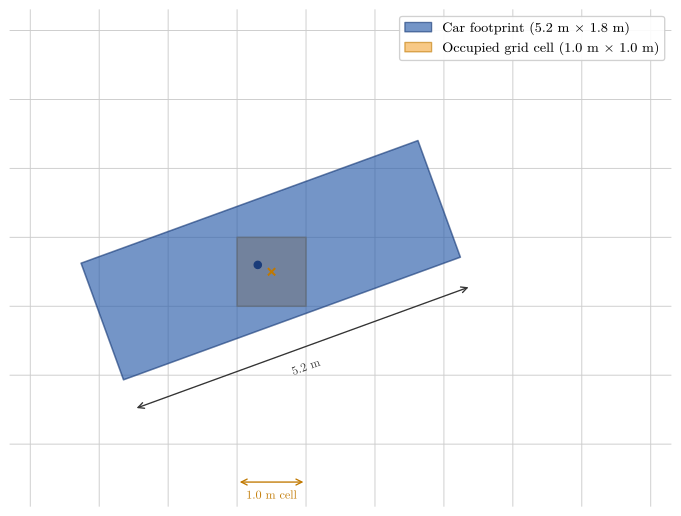
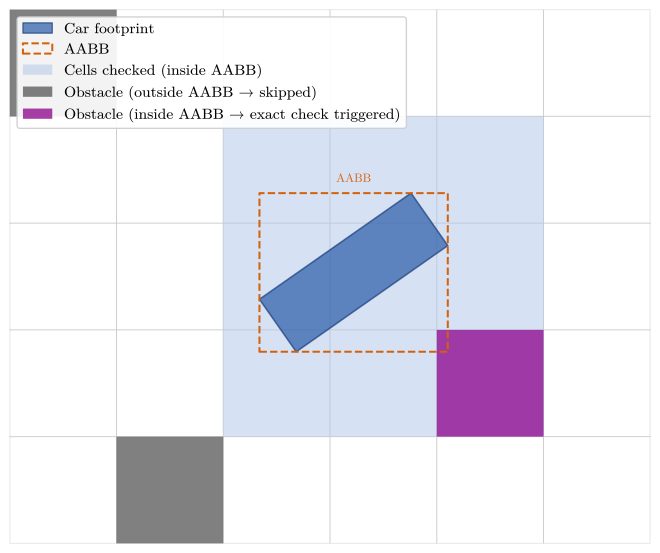
Cached alongside each footprint is its axis-aligned bounding box, so translating it to a state is an offset addition. The box is tested against the field boundary, then against the obstacle grid cells it covers — and only if a cell is occupied does the exact Shapely check run. The filter eliminates the vast majority of exact tests at negligible cost, and since it can only produce false positives, it costs no accuracy.
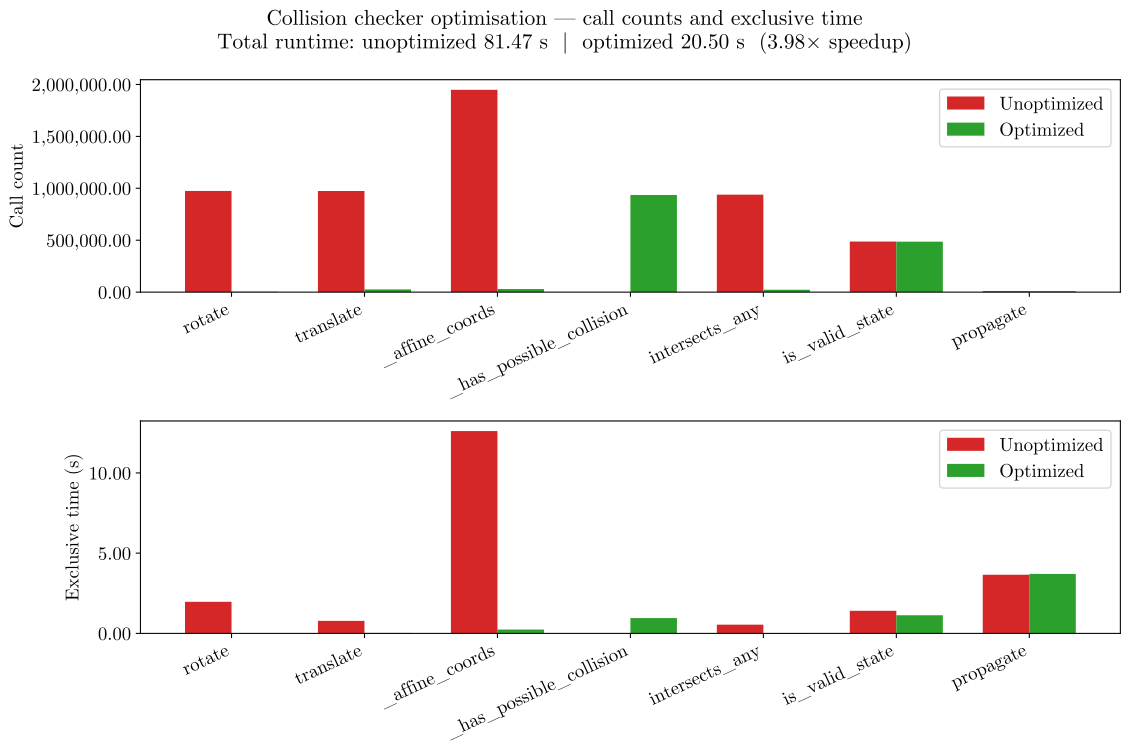
Together the two changes produced a 3.98× end-to-end speedup (81.5 s → 20.5 s on a profiled trailer run), with rotate calls dropping from 974,294 to 3,622. The control in the comparison is propagate (primitive generation), which is untouched by either change and shows identical cost in both profiles.
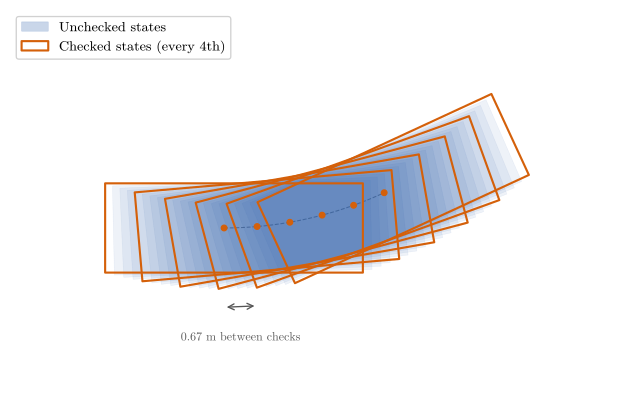
One more trick: entire primitive trajectories are validated by checking only every 4th state. At the simulation timestep the car moves 0.167 m between states — far less than its 5.2 m body — so consecutive footprints overlap almost entirely, and a collision missed at a skipped state is nearly certain to appear at a checked one. The final accepted path gets an exact full-resolution pass.
The Trailer
The truck follows the same closed-form arcs as any Ackermann vehicle, but the trailer heading is coupled through a nonlinear ODE,
where is the hitch-to-axle distance — no closed form alongside the arc, so is stepped through the precomputed truck states with Euler’s method. Any primitive that folds the rig past is discarded as a jackknife, and last-shot connections are additionally rejected if the trailer arrives outside a heading tolerance.
Post-Processing
The raw search output is valid but ugly — the search optimizes for reaching the goal, not for looking like driving. Two passes fix it: probabilistic shortcutting (pick two random path indices, try a direct Reeds-Shepp connection, keep it if collision-free, repeat 100 times), then arc-length resampling so playback runs at constant velocity, with pure rotations resampled at their own angular rate.
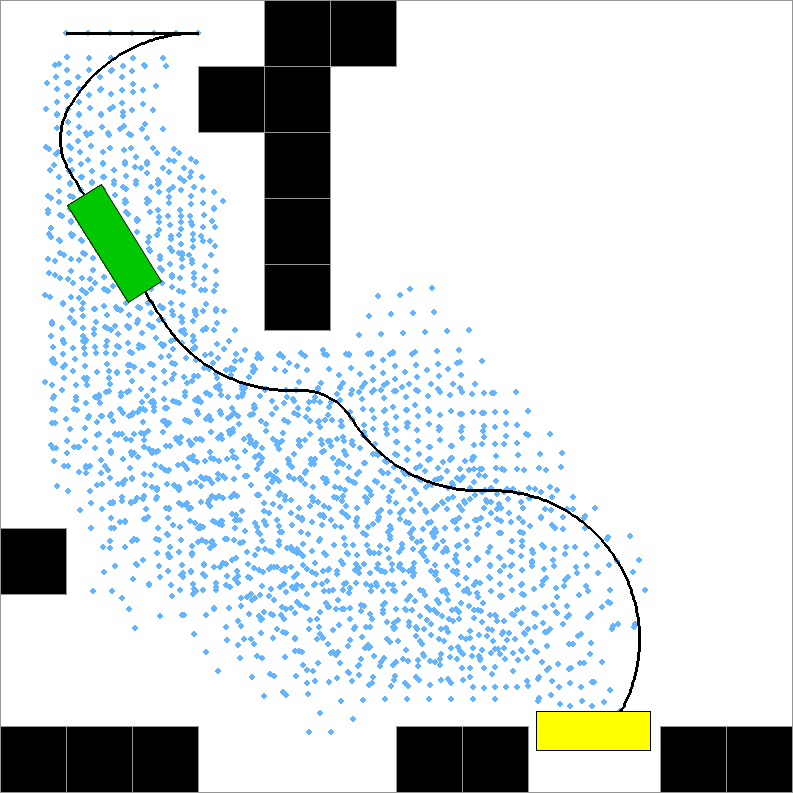
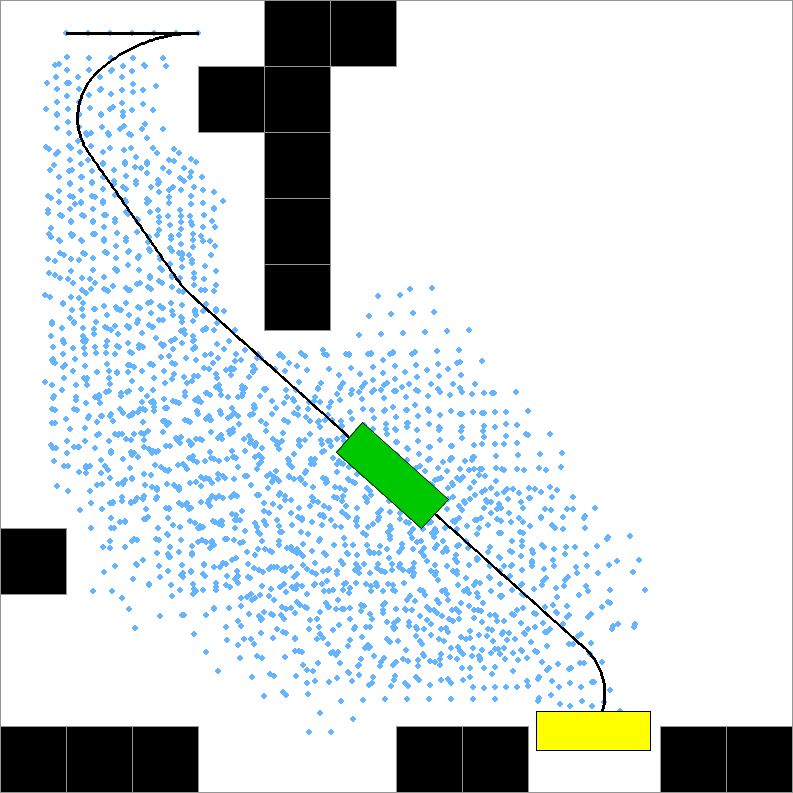
Results
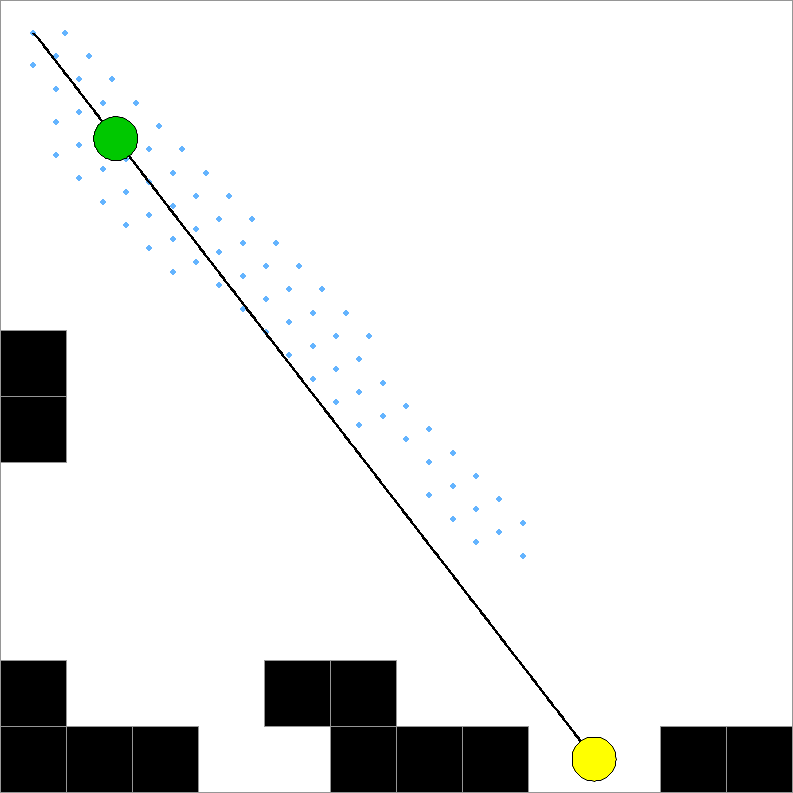
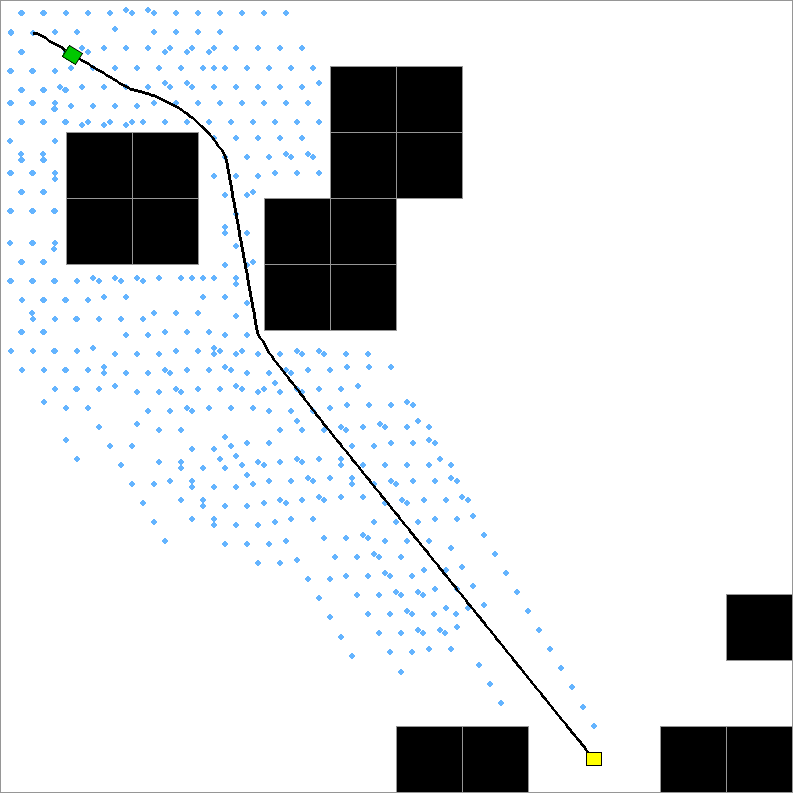
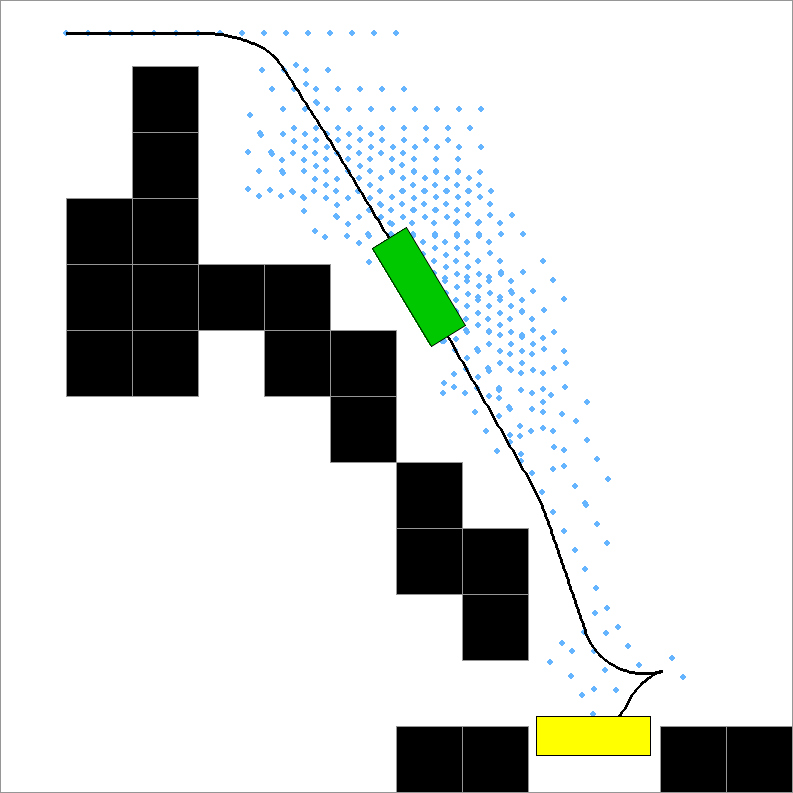
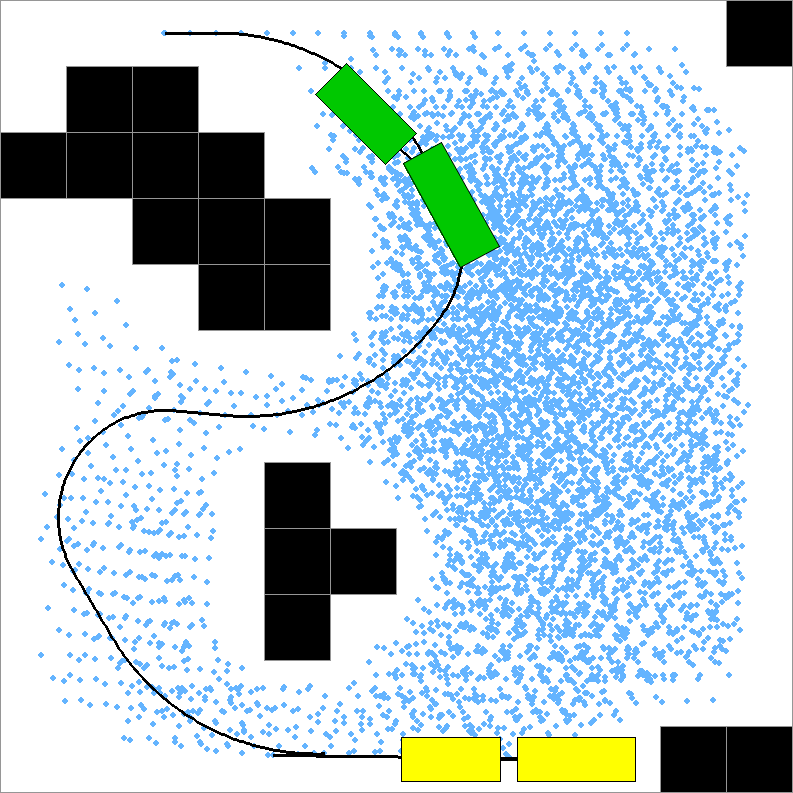
Over 10 runs per vehicle at 10% obstacle density:
| Vehicle | State dims | Success | Avg time | Avg expansions |
|---|---|---|---|---|
| Differential drive | 10/10 | 1.3 s | 1930 | |
| Ackermann car | 8/10 | 1.3 s | 1905 | |
| Trailer | 7/10 | 9.5 s | 8548 |
The car’s misses trace to an unhandled edge case — its footprint occasionally spawns boxed in by obstacles. The trailer pays for its fourth state dimension and per-step ODE work, and some of its failures are genuine: layouts with no reachable path under the jackknife constraint. Failed runs exhaust the search space and terminate cleanly rather than hanging.
The typing experiment held up too: the Protocol-based vehicle interface kept all four vehicles swappable through one planner, and parameter tuning rarely broke anything unexpected. Whether the up-front type-system work paid for itself is debatable — but it survived contact with the trailer.
References
- Reeds, J. A. & Shepp, L. A. Optimal paths for a car that goes both forwards and backwards, Pacific Journal of Mathematics, 1990.
- Dolgov, D., Thrun, S., Montemerlo, M., & Diebel, J. Practical Search Techniques in Path Planning for Autonomous Driving, 2008.
- Kurzer, K. Path Planning in Unstructured Environments: A Real-time Hybrid A* Implementation, KTH, 2016.
- LaValle, S. M. Planning Algorithms, Cambridge University Press, 2006.
- Geraerts, R. & Overmars, M. H. Creating High-quality Paths for Motion Planning, IJRR, 2007.
- Amanatides, J. & Woo, A. A Fast Voxel Traversal Algorithm for Ray Tracing, Eurographics, 1987.